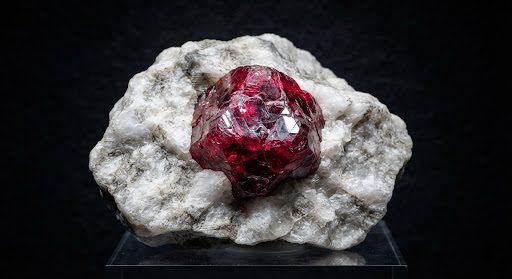
Near Ipanko — also written Epanko or Ipangko — south of the town of Mahenge, miners recovered several enormous pinkish-red spinel crystals. The largest is generally reported as weighing approximately 52 kilograms, although some later gemmological sources describe crystals from the discovery as reaching approximately 54 kg.
Size alone did not make the find remarkable. Portions of these enormous crystals possessed the transparency and vibrant pink-to-red colour necessary to produce exceptional faceted gemstones, including stones weighing many tens of carats.
The sudden appearance of this material drew international attention to Mahenge and helped propel spinel from an often overlooked gemstone into the modern coloured-stone spotlight.
GIA later described Mahenge as the first widely recognised spinel deposit outside Asia and identified the 2007 discovery as a pivotal event in the development of the deposit.
Where did the 2007 spinels come from?
The famous discovery occurred in the Ipanko Valley, approximately seven kilometres south of Mahenge township in Tanzania's Morogoro Region.
The locality is referred to by several spellings in gemmological literature, including:
- Ipanko
- Epanko
- Ipangko
These generally refer to the same celebrated mining area associated with the giant 2007 crystals.
SSEF describes the famous pinkish-red Mahenge spinels as coming specifically from Epanko or Ipanko rather than from Mahenge town itself. Mahenge nevertheless became the internationally recognised geographic name used by the gemstone trade.
The mining area lies in a metamorphic geological environment dominated by marble. During a 2009 visit, SSEF documented spinel occurring both within marble and in eluvial gravels accumulated in pockets within weathered karstic marble formations.
Importantly, SSEF reported that the giant crystal discovered in 2007 came from these eluvial deposits.
This geological setting helps explain why Mahenge is often compared with other famous marble-hosted spinel localities, including those in Myanmar and Central Asia.
How large were the Mahenge spinel crystals?
The most widely cited account describes four giant spinel crystals recovered from the Ipanko mining area during 2007.
Their reported weights were approximately:
| Crystal | Reported weight |
|---|---|
| Largest crystal | 52 kg |
| Second crystal | 28 kg |
| Third crystal | 20 kg |
| Fourth crystal | 5.7 kg |
GIA records these four enormous crystals as ranging from 5.7 to 52 kg and places the discovery in the Ipanko Valley during 2007.
Another GIA account connects the stones to a productive zone within the mining area known as the “Joel Box”, named after the miner associated with the discovery. The same account gives the weights as 52, 28, 20 and 5.7 kg.
Some later sources, including GIA and SSEF publications, refer to giant Mahenge crystals reaching approximately 54 kg. This small difference is worth acknowledging: historical reports are not completely consistent about the precise maximum weight.
What is not disputed is the extraordinary scale of the find.
Gem-quality spinel crystals weighing tens of kilograms are exceptional.
Was the entire 52 kg crystal gem quality?
No.
This is one of the most important details when understanding the discovery.
An enormous rough crystal does not translate directly into an equally enormous quantity of fine faceted gemstone.
GIA's later account of the discovery reports that the outer portions of the giant crystals contained exceptional cuttable material, while much of their interiors were substantially lower quality.
The largest crystal was reportedly broken into smaller pieces to make transportation possible. The eventual cutting yield has been reported as being as low as approximately 3%.
Even a small percentage of a 52 kg crystal, however, represents an extraordinary volume of gemstone rough.
A 52 kg crystal is equivalent to approximately 260,000 carats of rough material before cutting.
At a hypothetical 3% facetable yield, that would still represent thousands of carats of potential finished gemstone material.
The discovery was therefore capable of introducing a significant quantity of unusually large, strongly coloured spinel into a market where top-quality stones of substantial size are normally rare.
What colour was the 2007 Mahenge spinel?
The material from the famous discovery is most strongly associated with saturated pink, pinkish-red and orangy pinkish-red colours.
Contemporary GIA reporting from the 2008 Tucson gem shows described faceted stones cut from the enormous Mahenge crystal as orangy pinkish red. GIA illustrated 6.77 ct and 12.07 ct spinels reportedly cut from the 52 kg crystal recovered near Mahenge in late 2007.
Later descriptions emphasised the bright, vivid character of the material.
This colour became so strongly connected with the locality that “Mahenge” itself began to be used within parts of the trade as a descriptive shorthand for vivid pink-to-red spinel.
That usage should be treated carefully.
Mahenge is a geographic origin, not an official colour grade. Not every spinel mined around Mahenge possesses the famous saturated pink-red appearance, and similarly coloured spinels can occur elsewhere.
The individual stone must always be judged on its own colour, transparency, cut and gemmological characteristics.
The exceptional gemstones cut from the discovery
One of the reasons the 2007 discovery became legendary is the size of some of the faceted gemstones produced from the rough.
At the 2015 Tucson gem shows, GIA documented an 18.21 ct triangular red Tanzanian spinel that dealer Bruce Bridges attributed to rough from one of the giant Ipanko crystals. According to the account, the material was cut in Bangkok in 2007.
GIA also documented a spectacular 61.29 ct red spinel marquise shown by Axel Henn.
Henn reported that the stone came from large Tanzanian spinel crystals from the same period. GIA considered this likely to be the widely reported 2007 Ipanko discovery. A group of stones cut from the material totalled approximately 174.58 carats.
The Swiss Gemmological Institute SSEF has separately examined exceptional Mahenge material, including a 104 ct spinel from the locality. SSEF notes that the 2007 discovery created a sudden supply of vivid pinkish-red stones, some approaching or exceeding 100 carats.
These extraordinarily large stones demonstrate why the discovery attracted such attention.
Fine red and pink spinel is already scarce in large sizes. The ability of one deposit to produce strongly coloured, transparent stones weighing tens of carats was highly unusual.
Mahenge spinel existed before 2007
The story of Mahenge spinel should not begin with the giant crystals.
Spinel was known from Tanzania before 2007, and Mahenge itself had already produced material.
GIA reported new spinel from mining localities around Kibangili and Ipanko in the Mahenge area at the 2006 Tucson shows. According to information supplied to GIA at the time, production from these locations had begun around the middle of 2005. Those earlier stones included blue, violet and purple material.
GIA's broader historical review places the discovery of red spinel near Mahenge and the Uluguru Mountains as far back as the late 1980s.
The accurate interpretation is therefore:
2007 was not the discovery of spinel at Mahenge.
It was the extraordinary discovery that made Mahenge internationally famous.
That distinction matters because gemstone histories are often simplified over time until an important event becomes incorrectly described as the beginning of the entire deposit.
From Tanzania to Bangkok
Like many important East African coloured gemstones, much of the Mahenge rough entered an international cutting and trading network.
Bangkok was particularly important.
GIA records the 18.21 ct spinel associated with the giant-crystal discovery as having been cut in Bangkok in 2007.
Thailand has long been one of the world's principal centres for coloured gemstone cutting and trading, making Bangkok a natural destination for valuable Tanzanian rough requiring experienced evaluation and cutting.
This stage was critical.
The giant crystals may have been spectacular geological objects, but it was the cutting of their best transparent portions into finished gemstones that revealed their importance to collectors and jewellery buyers.
By the following year's Tucson shows, finished Mahenge stones were already attracting international attention.
How the discovery changed spinel
The influence of the 2007 find extended beyond Tanzania.
GIA's review of important gemstone localities of the 2000s states that the discovery of large, high-quality red-to-pink spinel crystals in Mahenge brought renewed interest in spinel as a gem mineral.
That is significant.
For centuries, spinel had lived partly in the shadow of ruby.
Historic red spinels were frequently mistaken for ruby, while even in the modern jewellery market spinel remained less familiar to the public than ruby, sapphire and emerald.
Mahenge arrived at a time when collectors and dealers were increasingly looking beyond the traditional “big three” coloured gemstones.
The combination of:
- extraordinary crystal size
- intense pink-red colour
- strong transparency
- large faceted stones
- comparatively limited treatment
- a new African origin
gave the gemstone an unusually compelling story.
SSEF described the sudden supply of vibrant pinkish-red Mahenge stones following the 2007 discovery as material that immediately captured the attention of the market.
The discovery also changed the Mahenge mining district
Major gemstone discoveries can transform mining areas quickly.
Once the value of the giant crystals became apparent, attention around Ipanko increased.
GIA notes that the Mahenge deposit subsequently experienced disputes surrounding mining licences and remained largely associated with small-scale mining operations.
When SSEF visited the Ipanko deposit in October 2009, multiple workings and concessions were operating along the valley. Researchers observed miners working both marble outcrops and secondary deposits and collected spinel samples alongside associated minerals including apatite, pargasite and chondrodite.
Mahenge remains an active gemstone district today rather than simply a historic deposit.
GIA has continued to conduct fieldwork in the region as demand for spinel has encouraged renewed mining activity.
Is spinel from the original 2007 discovery still available?
Gemstones from the original giant crystals continue to exist in private collections and within the international gemstone trade, but confidently establishing that an individual stone came specifically from the 2007 giant-crystal find requires meaningful provenance.
A laboratory may be able to support a geographic origin of Tanzania or Mahenge where sufficient evidence exists, but geographic origin is not the same thing as proving that a stone came from one particular crystal discovered in 2007.
Claims such as:
“cut from the original 52 kg Mahenge crystal”
should therefore ideally be accompanied by documented ownership history, dealer records, photographs, cutting records or another credible provenance trail.
For historically important coloured gemstones, provenance deserves the same care as gemmological identification.
Why the 2007 Mahenge discovery still matters
Nearly two decades later, the 2007 discovery remains the defining event in the modern history of Mahenge spinel.
Four enormous crystals emerged from a Tanzanian mining valley.
Parts of them yielded some of the finest large pink and red spinels seen in the modern market.
The resulting gemstones appeared in international trading centres, gem shows, laboratories and important private collections.
More importantly, the discovery helped change the way spinel itself was perceived.
Mahenge demonstrated that spinel could stand independently as one of the world's great coloured gemstones — not as a substitute for ruby, but as a gem with its own colour, optical character, geology and collecting history.
The giant crystals are therefore more than an extraordinary mining story.
They mark the moment when Mahenge became one of the defining names in modern spinel.