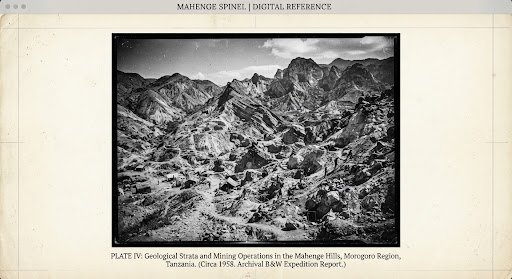
The name Mahenge has become firmly established within the coloured-gem trade, but the geography deserves more precision than the name alone suggests. Many of the famous pinkish-red stones sold as Mahenge spinel originate not from Mahenge town itself but from deposits around Epanko or Ipanko, a mining locality approximately seven kilometres south of the township.
It was there that several enormous pinkish-red spinel crystals were discovered in 2007, including a crystal reported at approximately 52–54 kilograms. That discovery transformed Mahenge from an important East African gem locality into one of the defining names in modern spinel.
Understanding Mahenge therefore means understanding both a place and a gemstone origin.
Where is Mahenge?
Mahenge is located in southern Morogoro Region in central-eastern Tanzania, within Ulanga District Council.
Mahenge town is the administrative headquarters of Ulanga District. The official Ulanga District Council website places the district in southern Morogoro Region and identifies Mahenge Mjini as its headquarters.
Ulanga District Council — official government websiteApproximate coordinates
8.6833° S, 36.7167° E8°41′ south · 36°43′ eastThis is important because Mahenge should not be confused with Tanzania's other famous gemstone-producing regions.
Tanzania contains numerous coloured-stone localities, including Merelani for tanzanite and tsavorite, Longido and the Uluguru Mountains for ruby, Tunduru and Songea for sapphire, and Mahenge for ruby and particularly spinel.
GIA field gemologists have described Mahenge as one of Tanzania's major coloured-gem mining districts and, during a 2016 expedition, called it the country's second most active gemstone mining area at that time.
GIA — Update on Colored Gemstone Mining in TanzaniaIs Mahenge spinel actually mined in Mahenge?
The answer is around Mahenge, rather than generally inside Mahenge town itself.
The famous pinkish-red material associated with the Mahenge name is particularly linked with Epanko — commonly written Ipanko in gemmological literature.
The Swiss Gemmological Institute SSEF states that the renowned pinkish-red Mahenge spinels are actually found at Epanko or Ipanko, approximately seven kilometres south of the small township of Mahenge.
SSEF — New Cobalt-Bearing Spinel from Lukande, TanzaniaThis distinction is useful when reading laboratory reports, field studies and dealer descriptions.
Mahenge functions as the recognised regional origin name, in much the same way that famous gemstone names elsewhere can refer to a wider mining district rather than a single pit.
Epanko, Ipanko or Ipangko?
All three spellings appear in reputable gemmological literature.
- Epanko
- Ipanko
- Ipangko
GIA commonly uses Ipanko, while SSEF publications have used both Epanko/Ipanko and Ipangko.
They refer to the locality south of Mahenge associated with the celebrated pink-red spinel deposits.
For consistency, MahengeSpinel.com generally uses Ipanko/Epanko when explaining the locality and retains the spelling used by a source when discussing a particular research paper.
This variation in spelling is one reason researching gemstone origins through trade descriptions alone can become confusing.
The Mahenge Mountains and Ipanko Valley
The mining area sits within the landscape of the Mahenge massif and Mahenge Mountains.
During a field visit in October 2009, SSEF gemmologist Dr Michael S. Krzemnicki documented the Ipanko spinel deposit directly.
SSEF described the mining zone as extending along a valley running southwards from the Mahenge massif. Some spinel was recovered directly from marble, but much of the production observed was associated with eluvial gravels accumulated in pockets within karstic marble formations.
SSEF — Spinel, a Gemstone on the Rise / Mahenge field observationsThis distinction between primary and secondary or eluvial deposits is important.
Primary deposits
A primary deposit preserves the gemstone relatively close to the rock in which it formed.
At Mahenge, spinel can occur in association with marble.
Eluvial deposits
Over time, weathering breaks down the host rock.
More resistant minerals such as spinel can remain concentrated close to their original source, accumulating in weathered material, gravels and cavities.
SSEF reported that even the famous giant spinel recovered in 2007 came from these eluvial deposits within the karstic marble environment.
The result is a mining environment where gemstones may be recovered both from their geological host and from weathered material derived from it.
Why does marble matter?
Some of the world's most important ruby and spinel deposits are connected with metamorphosed carbonate rocks such as marble.
The Mahenge area belongs to a wider East African geological environment that has undergone intense metamorphism during its geological history.
Field studies around Mahenge have repeatedly documented ruby and spinel associated with marble-type deposits.
During SSEF's Ipanko visit, researchers collected spinel alongside minerals including apatite, pargasite and chondrodite, as well as translucent ruby from a nearby calcite-marble outcrop.
GIA has likewise documented marble-associated ruby and spinel deposits across the broader Morogoro region.
GIA field report on Tanzanian coloured-gem miningA dedicated geological guide will examine the formation of Mahenge spinel in greater detail.
Explore: Geology of Mahenge SpinelMahenge produced spinel before 2007
Mahenge is famous for the giant spinel discovery of 2007, but gemstone production in the district predates it.
GIA's historical review states that red spinel was discovered near Mahenge and the Uluguru Mountains in the late 1980s.
GIA — Red Spinel and Its SourcesThere is also direct documentation of Mahenge-region spinel entering the trade in the early 2000s.
At the 2004 Tucson gem shows, GIA reported pink to pink-orange spinel from a new find in the Mahenge region. According to the supplier interviewed by GIA, that particular discovery had occurred in August 2003, although ruby and pink-to-red spinel had already been mined in the area for several years.
GIA — Spring 2004 Gems & Gemology reportTwo years later, GIA reported additional spinel from new mining locations near the villages of Kibangili and Ipanko, with production said to have begun around mid-2005. Those stones included blue, violet and purple spinel rather than only the vivid pink-red material for which Mahenge later became famous.
GIA — Spring 2006 Mahenge spinel reportThis history helps correct one of the most common oversimplifications about Mahenge:
Mahenge spinel was not first discovered in 2007.
The 2007 discovery was the event that made the locality internationally famous.
Explore: The 2007 Mahenge Spinel DiscoveryThe 2007 Ipanko discovery
In spring 2007, the Ipanko Valley produced four extraordinary spinel crystals reportedly weighing approximately:
- 5.7 kg
- 20 kg
- 28 kg
- 52 kg
GIA records that the crystals yielded many clean faceted gemstones in double-digit carat sizes and describes Mahenge as the first widely recognised spinel deposit outside Asia.
GIA — Field Gemology: Development of Gem DepositsSSEF describes the same deposit as producing giant pinkish-red crystals reaching approximately 54 kg and later yielding exceptional faceted stones, some larger than 50 carats.
SSEF — Mahenge and Lukande spinel researchThat event established the connection between the word Mahenge and the vivid pink-red spinel now sought by collectors around the world.
Mining at Ipanko
Mahenge remains a working gemstone district rather than simply a historical source.
Mining has traditionally involved artisanal and small-scale operations, although machinery has also been used on some deposits.
When GIA returned to Mahenge during its 2016 Tanzania field expedition, Ipanko remained the principal spinel deposit in the region.
Researchers observed that mining pits had become considerably larger than during an earlier visit in 2012. Excavators were working secondary deposits, while the nearby primary deposit remained active.
GIA reported approximately 400 people mining red spinel at the primary deposit during the visit, with smaller numbers working ruby.
GIA — 2016 Mahenge mining field reportMining intensity naturally changes over time.
A gemstone locality should not therefore be understood as continuously producing the same quantity or quality of material from year to year.
Exceptional discoveries can be followed by quieter periods, new workings, changes in licence ownership and the gradual development of previously unexplored areas.
Mahenge is more than one spinel deposit
The fame of the pink-red Ipanko material can make it seem as though Mahenge produces only one type of gemstone.
It does not.
The wider Mahenge district has produced or hosted:
- pink and red spinel
- purple and violet spinel
- ruby
- sapphire
- garnet
- other associated minerals
More recently, the wider district has produced an entirely different type of notable spinel.
In September 2021, cobalt-bearing blue spinel was reported from Lukande, approximately 15 kilometres south-east of Mahenge.
SSEF found that cobalt contributed significantly to the blue colour of these stones and described the deposit as occurring in weathered marble within an eluvial zone.
SSEF — Cobalt-Bearing Spinel from LukandeLukande should not simply be folded into the classic definition of pink-red Mahenge spinel, but its discovery reinforces the geological importance of the wider gemstone district.
Why is the origin called “Mahenge”?
Gemstone origin names frequently develop through a mixture of geography, trading history and international recognition.
In this case, Mahenge is the principal town and recognised gem-trading name associated with the deposits surrounding it.
A trader in Bangkok, Geneva, London or New York is far more likely to describe a vivid Tanzanian pink spinel as:
Mahenge spinel
than:
Ipanko Valley spinel
The broader term became internationally established after the 2007 discovery.
That does not make it inaccurate.
It simply means there are different levels of geographic precision:
- Country
- Tanzania
- Region
- Morogoro
- District
- Ulanga
- Recognised gem origin
- Mahenge
- Important pink-red spinel locality
- Ipanko/Epanko
For a collector, documenting both the recognised origin and the more precise locality — when reliably known — creates a better provenance record.
Can a laboratory prove Mahenge origin?
Geographic origin determination is more complex than matching a gemstone's colour to a location.
A vivid pink spinel cannot be assumed to be from Mahenge simply because it looks like material associated with the deposit.
Gem laboratories may study combinations of:
- microscopic inclusions
- trace-element chemistry
- spectroscopy
- structural features
- comparison with reference samples of known origin
SSEF specifically notes that it only assigns geographic origin to spinel where sufficient microscopic, chemical and spectroscopic evidence is available. Its researchers have collected reference samples directly from the Ipanko mine to strengthen this work.
SSEF — Mahenge field research and origin determinationThis is why reliable reference collections are important.
GIA likewise emphasises that geographic origin work depends on well-documented samples collected as close as possible to their actual source.
GIA — Building a Gemstone Research CollectionA dealer's statement of origin can be valuable provenance information, but it is not equivalent to independent laboratory analysis.
Mahenge: a place behind the gemstone
It is easy for a famous origin name to become detached from the landscape that created it.
Mahenge is not simply a marketing adjective attached to pink spinel.
It is a real Tanzanian town surrounded by a working gemstone district, metamorphic mountains, marble-hosted deposits and generations of small-scale mining.
Its spinel history stretches back well before 2007.
Its deposits have produced material ranging from violet and purple through saturated pink and red, while newer discoveries around the district continue to expand what is known about Tanzanian spinel.
Most importantly, the spectacular Ipanko discovery connected this relatively small part of Tanzania with the international gemstone world.
For collectors and gemmologists, understanding where Mahenge spinel comes from adds another layer to understanding the stone itself.
A Mahenge spinel is not defined by geography alone.
But its geography is an essential part of its story.
Primary sources and further reading
GIA · Field observations
Update on Colored Gemstone Mining in Tanzania
Field observations from Mahenge and Ipanko during the 2016 GIA expedition.
Read at GIAGIA · Field gemology
Building a Research Collection and Understanding the Development of Gem Deposits
Includes the four giant Ipanko crystals and the development of Mahenge as a major spinel source.
Read at GIAGIA · Historical overview
Hunting for “Jedi” Spinels in Mogok
Contains a useful historical overview of the world's major red-spinel sources, including Mahenge.
Read at GIASSEF · Field observations
Mahenge field observations and origin research
Includes SSEF's 2009 visit to Ipanko and descriptions of the marble and eluvial mining environment.
Read the SSEF publicationSSEF · Research
New Cobalt-Bearing Spinel from Lukande, Tanzania
Provides geographic clarification on Epanko/Ipanko relative to Mahenge and documents the newer Lukande deposit.
Read at SSEFGovernment source
Ulanga District Council
Official Tanzanian government source for the modern administrative location of Mahenge.
Visit Ulanga District Council